

 Recently, I discovered the world of railroad velocipedes — bicycles that ride the rails.
What led me there was a TV reality show, “American Pickers.” One of the buyers is Mike Wolfe, a bicycle enthusiast who occasionally dredges up vintage bikes; I guess that's what originally drew my interest.
Recently, he dragged a vintage railroad handcar out of a building. It was a 100-year-old one-person machine used to inspect the railroad tracks.
It occurred to me that this might be a cool way to travel on some abandoned railways that hadn't been converted to rail-to-trail bike paths. I live a couple of miles from an abandoned BNSF railroad line that is years away from conversion to another use.
Doing some research, I found there lots of folks who are way, way ahead of me on this idea. Some by more than a century. Instead of using handcars, they're using self-propelled vehicles called railbikes.
There are many styles, but most tend to be a vehicle that sits over one rail with an outrigger to the other rail. Others have four wheels with the rider straddling between them.
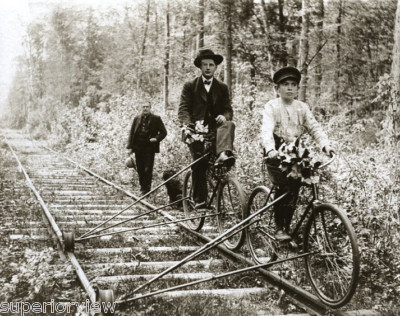
 Originally, small handcars were used by railroad and telegraph personnel for inspecting track and wire conditions. They were often called velocipedes and looked like they'd offer a good upper body workout. (Photo at left by Harvey Henkelmann.)
In other countries, such as Japan and China, they were used to carry goods and passengers to remote locations.
Railbikes are used mainly for recreation now. They utilize a mountain bike with an outrigger attached to the side and a front wheel guide to keep the bike heading straight down the tracks.
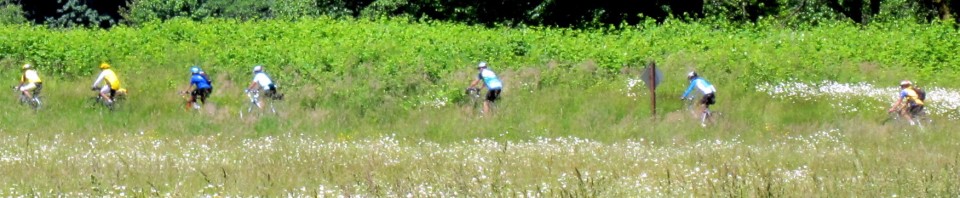
They're not much different than those railbikes shown at top, except they use the front wheel guide.
Plans for do-it-yourself railbikes are available on the web, or you can buy them ready-made.
The author of the Bentley Railbike website offers plans to convert bicycles in railbikes. He has several homemade railbikes that he uses on abandoned tracks near his home in the Adirondacks.
He says the secret to riding is leaning slightly inboard to keep the bike from tipping over.
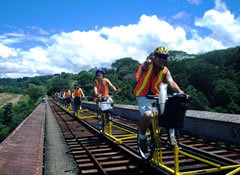 Railbike.com offers a slightly different design that looks like a platform that rides the rails with a bike used for propulsion. He offers used railbike frames for sale, shipped from Costa Rica. They cost about $450 each and you supply the bicycle.
Both of these railbikers emphasize that it's important to get permission from the railway owner before setting out by rail, even if the railway appears to be abandoned. Otherwise, users can be arrested for trespassing.
There are other railbike designs, including some for four-wheeled bikes that span the rails. Railrider website locates parks where self-propelled bikes are used on abandoned railroads.
I suppose these can be put to good use on abandoned railroad lines, as long as they don't get too popular. Imagine having to move off the rails whenever railbikers encounter each other traveling in opposite directions.

8 comments
Skip to comment form
Greetings, I am trying to get into the railroad biking but need to find a bike. Do I need to build one myself or is there someone who sells these. I live in Sacramento, California and we have so many rails around the house that it is an ideal way of getting out on the bike.
You might want to give RailBike.com a try. Otherwise, I think you’ll be making one yourself.
Hi Scott,
We are putting the finishing touches on a railbike bicycle retrofit that we will be offering for sale to railroad companies and those who have track that they need to evaluate for various reasons. I am also getting ready to start on a redesigned recumbent scratch built railbike that should be ready for the rails in 6-8 weeks. If you might be interested in one of these you can email me with a phone number that I can contact you at and a good time to call and I will make that happen. I’ve built around 100 railbikes in the last 20 years for use in commercial tours and for sale to railroads and individuals around the world: http://www.railbike.com
If you have general questions about railbking I’d also be happy to give you some information about that.
Please do not ride rail without authorization. People seem to think that as long as they aren’t walking between the rails that they are not trespassing – the actual case is that if you are walking or biking or otherwise on the right of way which is usually at least 60 feet wide you could be charged with trespassing. Because of the safety and liability issues involved railroads are understandably very concerned about any unauthorized folks being anywhere on the right of way. Right of way owners are the folks we need on our side in order for railbiking to become an accepted activity. They are unlikely to be receptive if they have the impression that railbikers are a renegade lot who flout the rules just because the rail is there. There are some railbikers who take the attitude that abandoned rails are ‘fair game’. The truth here is that ‘abandonment’ is a legal term that refers to a right of way owner applying for abandonment with the National Surface Transportation Board. If abandoned status is granted, it means that the right of way owner is not required to provide rail service to anyone who is along the line. This means that they can have equipment operating on it for access or maintenance reasons – not that the line is totally out of use.
Michael
Hello. This message is for Michael Rohde, or anyone who may read this. I live in Ct. I have an abandoned line now for 15 years that I even have written permission to be on! Although I’m somewhat handy, I’m also somewhat lazy. Lol. I tried a few ideas from Bentltly etc:: here is what I’m looking for. Someone to basically build me one. Or one for sale. My neighbor has an old speedster and I love it. But I love the bike idea, or the pedal or go art or both idea. Is there anyone out there who has one, or just can help a guy get started??? I like the bike on the tracks as my first pick, but open to anything reasonable, just to tinker to see if it’s what I want? Please email me back and point me in a possative direction! Thank you. Nick.
Nick63069@yahoo.com
I am very interested in a summer rail trip. I am a long time bicycle camper and would love to take a rail trip into the wilderness. Do you have any suggested routes? The old Donner Pass rail looks fantastic, but much of it seems non accessable, torn up, or tunnels not passable. The longer the better 150+ miles is great!
http://www.railriders.net/wheels.html – – with the illustrations on this site and the wheels that are sold there, you can conjure up a very nice rail rider in a fairly short time. They aren’t cheap to build, but once built require very little maintenance
.
I have a rail bike for sale bought in 2000 for $1480.00 never used.Bought from Railcycle Inc. Coeur d’ Alene, ID
Will except best offer. I would appreciate any help you can offer me.
Thank You,
Patty Schroeder
is rail bike still available could you please sent pix
t26048@verizon.net